OEM manufacturer ASME B16.5 · EN 1092-1 Type 12
Slip-On Flanges — ASME B16.5
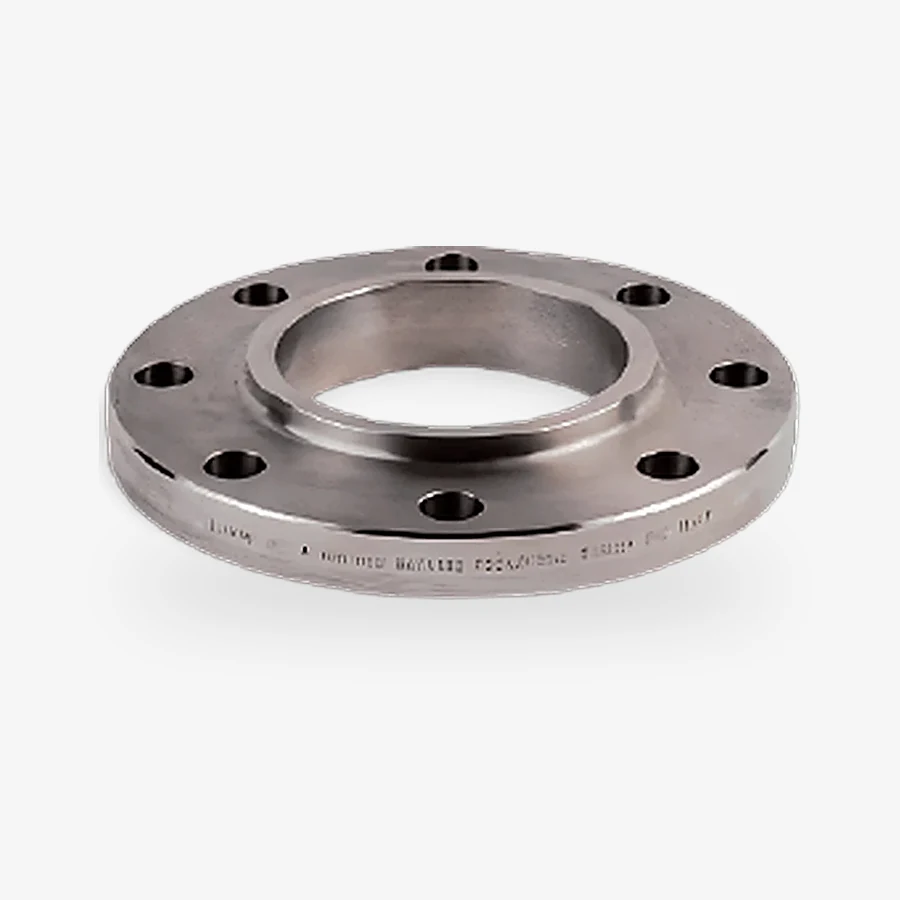
A slip-on flange is a hubbed flange that slides over the pipe and is fillet-welded on the inside and outside. Teshi Group manufactures forged slip-on flanges to ASME B16.5 in carbon, low-temperature and stainless steels, raised or flat face.
Also called: SO flange, SORF flange, slip on raised face flange, hubbed slip-on flange
What is a Slip-On Flange?
A slip-on (SO) flange has a bore slightly larger than the pipe OD, so the pipe passes into the flange and is held by two fillet welds: one at the hub and one inside the bore, set back from the face. It needs less precise pipe cutting than a weld neck and is easy to align on site. Under internal pressure its calculated strength is about two-thirds that of a weld neck, and its fatigue life is lower, so it is used mainly on low-pressure, non-cyclic services such as cooling water, utility air and fire water.
Key features
- Bore sized to pipe OD; no pipe-schedule matching needed
- Short hub, lighter and lower cost than a weld neck of the same size
- Two fillet welds; inside weld set back from the face so the face is not damaged
- RF or FF facing; serrated finish to ASME B16.5
- Also made as plate-type slip-on to EN 1092-1 Type 01 (see plate flange)
Specification
| Supply | OEM manufacturer — Teshi Group, India |
|---|---|
| Standard | ASME B16.5; EN 1092-1 Type 12 (hubbed slip-on) |
| Size range | NPS ½″–24″ |
| Pressure class | Class 150, 300, 600, 900; Class 1500 to NPS 2½″ (not covered in Class 2500) |
| Facing | RF, FF |
| Materials — carbon steel | ASTM A105 / A105N; ASTM A181 Cl 60, Cl 70; ASTM A266 Gr 2, Gr 4 (large forgings) |
| Materials — high-yield carbon steel | ASTM A694 F42, F46, F48, F50, F52, F56, F60, F65, F70 (MSS SP-44 grades F52–F70) |
| Materials — low-temperature carbon steel | ASTM A350 LF1, LF2 Cl 1, LF2 Cl 2, LF3, LF6, LF9 |
| Materials — alloy steel (Cr-Mo) | ASTM A182 F1, F2, F5, F5a, F9, F11 Cl 1 / 2 / 3, F12 Cl 1 / 2, F21, F22 Cl 1 / 3, F22V, F91, F92, F911; ASTM A336 F11, F22 (large forgings) |
| Materials — stainless steel | ASTM A182 F304, F304L, F304H, F304LN, F309H, F310, F316, F316L, F316H, F316LN, F316Ti, F317, F317L, F321, F321H, F347, F347H, F348 |
| Materials — 904L and 6Mo | 904L (ASTM A182 F904L, UNS N08904); 254 SMO / 6Mo (ASTM A182 F44, UNS S31254); AL-6XN (ASTM A182 F62, UNS N08367) |
| Materials — duplex stainless steel | ASTM A182 F51 (UNS S31803), F60 (UNS S32205, 2205) |
| Materials — super duplex stainless steel | ASTM A182 F53 (UNS S32750, 2507), F55 (UNS S32760), F61 (UNS S32550) |
| Materials — nickel alloys | ASTM B564 / B160 / B462: Nickel 200 / 201 (N02200 / N02201), Monel 400 (N04400), Monel K-500 (N05500), Inconel 600 (N06600), Inconel 625 (N06625), Inconel 718 (N07718), Incoloy 800 / 800H / 800HT (N08800 / N08810 / N08811), Incoloy 825 (N08825), Hastelloy C276 (N10276), Hastelloy C22 (N06022), Hastelloy B2 / B3 (N10665 / N10675), Alloy 20 (N08020) |
| Materials — titanium | ASTM B381 Grade F1, F2, F5 (Ti-6Al-4V), F7, F12 |
| Materials — copper-nickel | Cu-Ni 90/10 (UNS C70600) and 70/30 (UNS C71500), ASTM B151 bar; flanges to ASME B16.5 or EEMUA 145 |
| Grade availability | Every grade listed is made or supplied against order, with EN 10204 3.1 certificates (3.2 / third-party inspection when specified) and PMI on alloy, stainless, duplex and nickel grades. |
| Testing | Visual and dimensional inspection, PMI on alloy and stainless grades, hardness; UT, MPI/DPI as specified |
| Documents | EN 10204 3.1 mill test certificate; 3.2 / third-party inspection when the order specifies; dimensional inspection report; IBR certification when specified |
Applications
- Cooling water and utility water lines
- Plant and instrument air headers
- Fire water ring mains
- Low-pressure process and drain lines
- Tank and vessel connections in Class 150 service
Slip-on vs plate flange
Both slide over the pipe and are fillet-welded. A slip-on flange to ASME B16.5 has a raised hub, which adds stiffness and weld length; a plate flange (EN 1092-1 Type 01 or IS 6392) is a flat disc with no hub. Plate flanges are cheaper and suit low-pressure water and air; hubbed slip-on flanges are preferred where the line is specified to ASME classes or sees moderate temperature.
Technical data sheets
Dimensions & weights
FAQ
Slip-On Flange: common questions
Is a slip-on flange weaker than a weld neck?
Yes. Under internal pressure the calculated strength of a slip-on is roughly two-thirds of a weld neck, and its fatigue life is about one-third. It is suitable for low-pressure, non-cyclic services but is not normally used in Class 600 and above on hazardous lines.
Which classes of slip-on flange does ASME B16.5 cover?
ASME B16.5 lists slip-on flanges in Class 150 to 900, and Class 1500 only up to NPS 2½″. Class 2500 slip-on flanges are not covered by the standard.
What bore do slip-on flanges have?
The bore is slightly larger than the pipe outside diameter given in ASME B36.10 or B36.19, so one flange suits all schedules of a given NPS. You do not need to state the schedule, only the NPS.
Do you supply slip-on flanges in stainless steel?
Yes. Slip-on flanges are made in ASTM A182 F304, F304L, F316, F316L and F321, and in F51 duplex, supplied with EN 10204 3.1 certificates and PMI reports on every heat.
Need a size or grade not listed here?
Our engineering team manufactures against your drawing or datasheet, with dimensional sign-off before dispatch.
Send us your specificationTraceability
From mill heat to your site
- 01
Approved mill material
Received against the mill certificate; heat number registered.
- 02
Forging & machining
Heat number carried through every stage in our Indian works.
- 03
PMI, dimensional & NDT
Every lot inspected to the governing standard; TPI witness on request.
- 04
Stamped & certified dispatch
Hard-stamped pieces with EN 10204 3.1 / 3.2 certificates.
Quick RFQ
Quote for Slip-On Flange in 24–48 hours
More industrial flanges
All industrial flangesBlind Flange
ASME B16.5 · ASME B16.47
View productIndustrial FlangesSocket Weld Flange
ASME B16.5
View productIndustrial FlangesThreaded Flange
ASME B16.5 · ASME B1.20.1
View productIndustrial FlangesLap Joint Flange
ASME B16.5 · ASME B16.9
View productIndustrial FlangesPlate Flange
EN 1092-1 Type 01 · IS 6392
View productIndustrial FlangesRing Type Joint (RTJ) Flange
ASME B16.5 · ASME B16.47 Series A
View product