OEM manufacturer ASME B16.5 · ASME B16.9 · MSS SP-43 · EN 1092-1 Type 02 / Type 04
Lap Joint Flanges — ASME B16.5
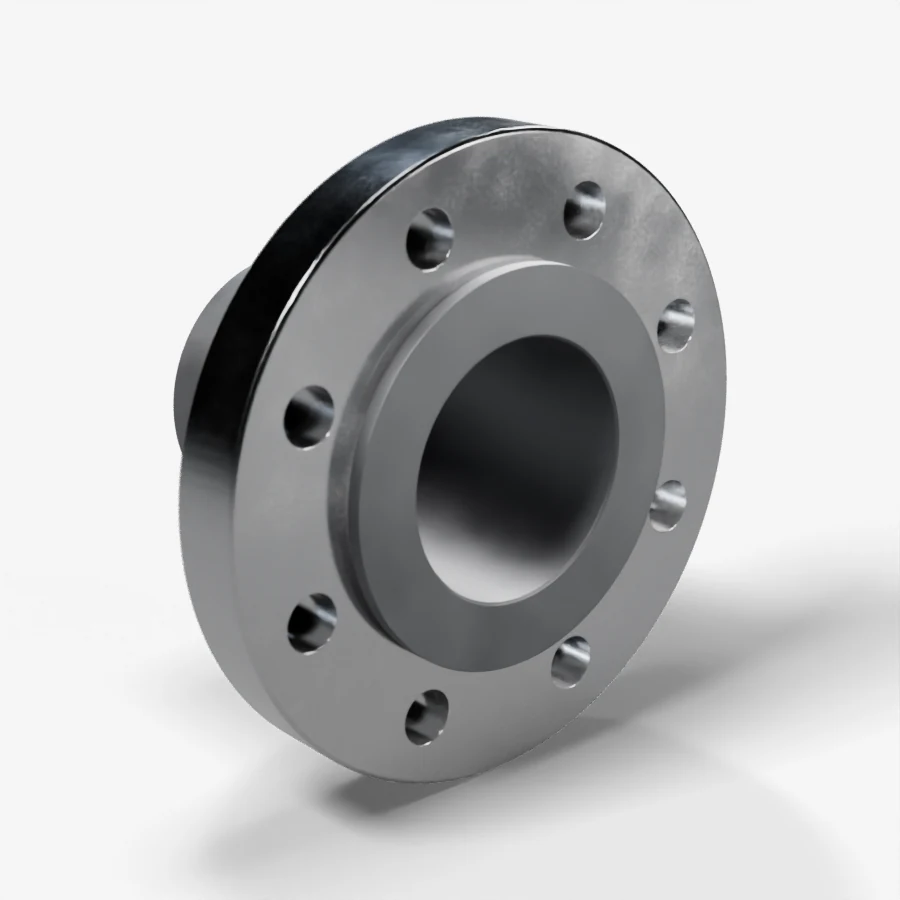
A lap joint flange is a loose backing flange that rotates freely over a stub end welded to the pipe. Teshi Group manufactures lap joint flanges to ASME B16.5 and supplies them with matching stub ends to ASME B16.9 or MSS SP-43.
Also called: LJ flange, loose flange, backing flange, Van Stone flange
What is a Lap Joint Flange?
A lap joint (LJ) flange has a flat face with a radius at the bore to sit against the lap of a stub end. Only the stub end is welded to the pipe and touches the fluid; the flange is a loose ring that turns to line up bolt holes. This makes lap joints useful on stainless, duplex or alloy lines, where the stub end is in the process alloy and the backing flange can be carbon steel, and on systems that are dismantled often. The joint has lower fatigue resistance than a weld neck.
Key features
- Loose ring rotates for easy bolt-hole alignment
- Only the stub end is wetted, so the flange can be a cheaper material
- Bore radius matches the stub end lap radius
- Supplied with Type A, B or C stub ends on request
- Easy dismantling for cleaning and inspection
Specification
| Supply | OEM manufacturer — Teshi Group, India |
|---|---|
| Standard | ASME B16.5 (flange); ASME B16.9 long-pattern or MSS SP-43 short-pattern stub ends; EN 1092-1 Type 02/04 with collars |
| Pressure class | Class 150–2500 per B16.5 tables (higher classes in smaller sizes only) |
| Materials — carbon steel | ASTM A105 / A105N; ASTM A181 Cl 60, Cl 70; ASTM A266 Gr 2, Gr 4 (large forgings) |
| Materials — high-yield carbon steel | ASTM A694 F42, F46, F48, F50, F52, F56, F60, F65, F70 (MSS SP-44 grades F52–F70) |
| Materials — low-temperature carbon steel | ASTM A350 LF1, LF2 Cl 1, LF2 Cl 2, LF3, LF6, LF9 |
| Materials — alloy steel (Cr-Mo) | ASTM A182 F1, F2, F5, F5a, F9, F11 Cl 1 / 2 / 3, F12 Cl 1 / 2, F21, F22 Cl 1 / 3, F22V, F91, F92, F911; ASTM A336 F11, F22 (large forgings) |
| Materials — stainless steel | ASTM A182 F304, F304L, F304H, F304LN, F309H, F310, F316, F316L, F316H, F316LN, F316Ti, F317, F317L, F321, F321H, F347, F347H, F348 |
| Materials — 904L and 6Mo | 904L (ASTM A182 F904L, UNS N08904); 254 SMO / 6Mo (ASTM A182 F44, UNS S31254); AL-6XN (ASTM A182 F62, UNS N08367) |
| Materials — duplex stainless steel | ASTM A182 F51 (UNS S31803), F60 (UNS S32205, 2205) |
| Materials — super duplex stainless steel | ASTM A182 F53 (UNS S32750, 2507), F55 (UNS S32760), F61 (UNS S32550) |
| Materials — nickel alloys | ASTM B564 / B160 / B462: Nickel 200 / 201 (N02200 / N02201), Monel 400 (N04400), Monel K-500 (N05500), Inconel 600 (N06600), Inconel 625 (N06625), Inconel 718 (N07718), Incoloy 800 / 800H / 800HT (N08800 / N08810 / N08811), Incoloy 825 (N08825), Hastelloy C276 (N10276), Hastelloy C22 (N06022), Hastelloy B2 / B3 (N10665 / N10675), Alloy 20 (N08020) |
| Materials — titanium | ASTM B381 Grade F1, F2, F5 (Ti-6Al-4V), F7, F12 |
| Materials — copper-nickel | Cu-Ni 90/10 (UNS C70600) and 70/30 (UNS C71500), ASTM B151 bar; flanges to ASME B16.5 or EEMUA 145 |
| Grade availability | Every grade listed is made or supplied against order, with EN 10204 3.1 certificates (3.2 / third-party inspection when specified) and PMI on alloy, stainless, duplex and nickel grades. |
| Stub end materials | ASTM A403 WP304L, WP316L; A815 duplex; A234 WPB |
| Facing | Flat contact face for stub end lap |
| Testing | Visual and dimensional inspection, PMI on alloy and stainless grades, hardness; UT, MPI/DPI as specified |
| Documents | EN 10204 3.1 mill test certificate; 3.2 / third-party inspection when the order specifies; dimensional inspection report; IBR certification when specified |
Applications
- Stainless and duplex process piping
- Food, pharma and water treatment lines dismantled for cleaning
- Seawater and cooling water systems
- Low-pressure chemical lines needing frequent disassembly
- Lines needing bolt-hole alignment on site
Lap joint vs slip-on flange
A slip-on flange is welded directly to the pipe and wetted at the bore, so it must be in the line material. A lap joint flange is never welded; it bears on a stub end. On a 316L or duplex line this lets you use a carbon steel backing flange and save cost, and the loose ring makes bolt alignment easy. The trade-off is an extra component and lower fatigue strength.
Technical data sheets
Dimensions & weights
FAQ
Lap Joint Flange: common questions
What is the difference between MSS SP-43 and ASME B16.9 stub ends?
ASME B16.9 stub ends are long pattern; MSS SP-43 stub ends are short pattern, mainly for thin-wall stainless pipe in Schedule 5S and 10S. Both work with a lap joint flange; the face-to-end length differs.
Can the lap joint flange be carbon steel on a stainless line?
Yes. Because the flange does not contact the fluid, an A105 backing flange, often painted or galvanized, is commonly used with a 304L or 316L stub end. Confirm with your piping class.
Which stub end type should I order?
Type A has a radius suited to a lap joint flange bore. Type B is for standard slip-on flanges used as backing rings. Type C can be used with either. Most lap joint flanges are paired with Type A.
Are lap joint flanges suitable for high pressure?
They are rated to the same pressure-temperature classes as other ASME B16.5 flanges, but their fatigue resistance is lower than a weld neck, so they are not preferred for cyclic or high-bending loads.
Need a size or grade not listed here?
Our engineering team manufactures against your drawing or datasheet, with dimensional sign-off before dispatch.
Send us your specificationTraceability
From mill heat to your site
- 01
Approved mill material
Received against the mill certificate; heat number registered.
- 02
Forging & machining
Heat number carried through every stage in our Indian works.
- 03
PMI, dimensional & NDT
Every lot inspected to the governing standard; TPI witness on request.
- 04
Stamped & certified dispatch
Hard-stamped pieces with EN 10204 3.1 / 3.2 certificates.
Quick RFQ
Quote for Lap Joint Flange in 24–48 hours
More industrial flanges
All industrial flangesPlate Flange
EN 1092-1 Type 01 · IS 6392
View productIndustrial FlangesRing Type Joint (RTJ) Flange
ASME B16.5 · ASME B16.47 Series A
View productIndustrial FlangesLong Weld Neck Flange
ASME B16.5 (flange end) · Manufacturer standard / client drawing (barrel)
View productIndustrial FlangesSpectacle Blind, Spade & Spacer
ASME B16.48
View productIndustrial FlangesOrifice Flange
ASME B16.36 · ASME B1.20.1
View productIndustrial FlangesReducing Flange
ASME B16.5
View product