OEM manufacturer ASTM A193 · ASTM A320 · ASTM A194 · ASME B16.5 · ASME B18.31.2
Stud Bolts — ASTM A193 & ASTM A320
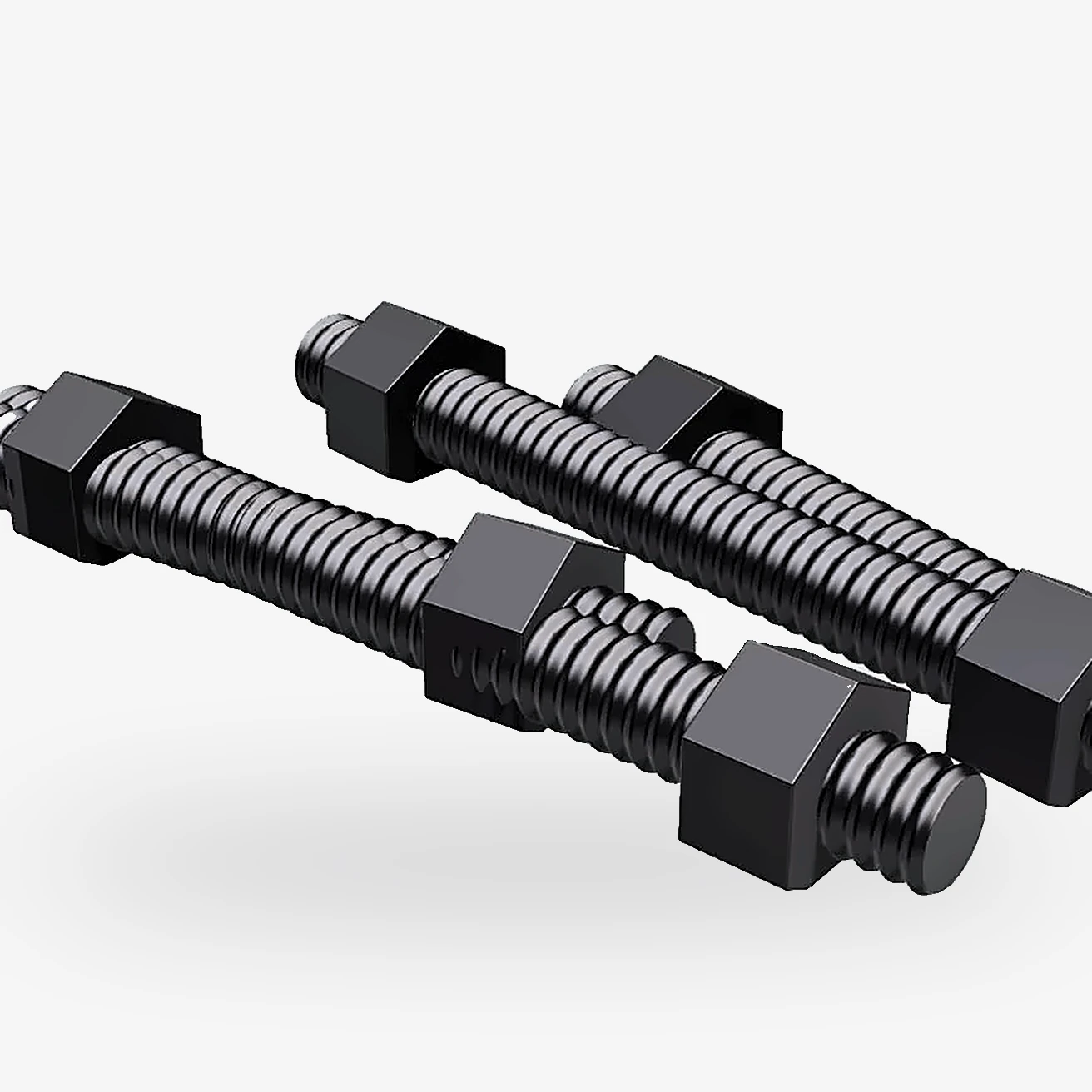
Stud bolts are fully threaded rods used with two heavy hex nuts to bolt pipe flanges, valves and pressure equipment. Teshi Group manufactures stud bolts and nut sets to ASTM A193 and ASTM A320 in alloy and stainless grades, cut to the lengths in the ASME B16.5 and B16.47 bolting tables.
Also called: flange stud bolts, full thread stud bolts, B7 stud bolts, threaded rod studs, stud bolt with nuts
What are Stud Bolts?
A stud bolt is a length of round bar threaded over its full length (or both ends) and fitted with two nuts. In flanged piping it passes through matching bolt holes and is tightened to compress the gasket. Studs are preferred over headed bolts on pressure flanges because both ends can be tightened, they are easier to remove after service and the bolting table length is standard. Grade is chosen by service: A193 B7 for general high-temperature service, B7M where hardness is limited, B8/B8M for corrosive service and A320 L7 for low-temperature service.
Key features
- Grades ASTM A193 B7, B7M, B16, B8 and B8M (Class 1 and Class 2) and ASTM A320 L7
- Supplied as sets with ASTM A194 heavy hex nuts (2H, 2HM, 7, 8, 8M)
- UNC threads up to 1" and 8UN for 1⅛" and larger, as specified for flange bolting in ASME B16.5
- Lengths to ASME B16.5 / B16.47 bolting tables or to drawing; metric studs on request
- Coatings: PTFE/Xylan, hot-dip galvanised, zinc or zinc-nickel electroplated
Specification
| Supply | OEM manufacturer — Teshi Group, India, India |
|---|---|
| Standard | ASTM A193 (high-temperature / high-pressure bolting), ASTM A320 (low-temperature bolting); continuous-thread studs to ASME B18.31.2 |
| Grades — alloy steel | A193 B7, B7M, B16; A320 L7 |
| Grades — stainless steel | A193 B8 (304) and B8M (316), Class 1 (solution treated) and Class 2 (strain hardened) |
| B7 mechanical (≤ 2½") | Tensile 125 ksi min, yield 105 ksi min, hardness 35 HRC max |
| B7M | Tensile 100 ksi min; hardness 235 HBW / 99 HRB max, every piece hardness tested |
| A320 L7 | Cr-Mo alloy steel, quenched and tempered, Charpy impact tested at −101 °C (−150 °F) |
| Threads | UNC / 8UN per ASME B1.1, class 2A; metric ISO threads on request |
| Nuts | ASTM A194 heavy hex 2H, 2HM, 7, 8, 8M |
| Coatings | Plain, PTFE/Xylan (fluoropolymer), hot-dip galvanised, zinc / zinc-nickel electroplated, as ordered |
| Testing | Tensile, hardness, PMI on stainless grades; Charpy impact for A320 L7 |
| Documents | EN 10204 3.1 mill test certificate (3.2 / third-party inspection when specified), dimensional inspection report |
Applications
- Flange joints in refinery and petrochemical piping
- Valve and pump flange bolting
- Heat exchanger and pressure vessel closures
- Cryogenic and low-temperature lines (A320 L7)
- Sour-service bolting (B7M with 2HM nuts)
- Power plant steam piping
A193 B7 vs A320 L7
Both grades are chromium-molybdenum alloy steel (AISI 4140/4142 type) with the same strength, 125 ksi tensile and 105 ksi yield up to 2½" diameter. The difference is toughness: A320 L7 is heat treated for low-temperature toughness and must pass a Charpy V-notch impact test at −101 °C (−150 °F). A193 B7 has no mandatory impact test. Use L7 where design metal temperature is below the B7 limit, and pair L7 with A194 Grade 7 nuts.
Technical data sheets
FAQ
Stud Bolts: common questions
What is the difference between B7 and B7M stud bolts?
B7M is the same Cr-Mo steel as B7, tempered to a maximum hardness of 235 HBW (99 HRB) with every piece hardness tested. Minimum tensile is 100 ksi against 125 ksi for B7. B7M is used where hardness limits apply, such as sour service.
Which nuts go with B7 stud bolts?
A193 B7 studs are normally paired with ASTM A194 Grade 2H heavy hex nuts. B7M uses 2HM, B8 uses Grade 8, B8M uses Grade 8M and A320 L7 uses Grade 7 nuts.
How is stud bolt length decided for a flange?
ASME B16.5 and B16.47 give stud bolt diameter, number and length for each flange size, class and facing. Lengths for RTJ facing are longer than for raised face. Our stud bolt chart page lists these values.
What is the difference between B8 Class 1 and Class 2?
Class 1 is carbide solution treated, with 75 ksi tensile and 30 ksi yield. Class 2 is solution treated and then strain hardened, giving higher strength that falls with increasing diameter.
Can stud bolts be supplied with PTFE coating?
Yes. PTFE/Xylan fluoropolymer coating, hot-dip galvanising and zinc or zinc-nickel plating are all available. Hot-dip galvanised studs need nuts tapped oversize so the nut still fits over the zinc coating thickness.
Need a size or grade not listed here?
Our engineering team manufactures against your drawing or datasheet, with dimensional sign-off before dispatch.
Send us your specificationTraceability
From mill heat to your site
- 01
Approved mill material
Received against the mill certificate; heat number registered.
- 02
Forging & machining
Heat number carried through every stage in our Indian works.
- 03
PMI, dimensional & NDT
Every lot inspected to the governing standard; TPI witness on request.
- 04
Stamped & certified dispatch
Hard-stamped pieces with EN 10204 3.1 / 3.2 certificates.
Quick RFQ
Quote for Stud Bolts in 24–48 hours
More fasteners
All fastenersHex & Heavy Hex Bolts
ASME B18.2.1 · ISO 4014
View productFastenersHeavy Hex Nuts
ASTM A194 · ASME B18.2.2
View productFastenersSocket Head Cap Screws
ASME B18.3 · ISO 4762
View productFastenersCarriage Bolts
ASME B18.5 · DIN 603
View productFastenersSquare Head Bolts & Square Nuts
ASME B18.2.1 · ASME B18.2.2
View productFastenersCoupling Nuts
ASME B18.2.2 · DIN 6334
View product