OEM manufacturer ISO 7040 · DIN 985 · DIN 980 · ISO 7042 · ASME B18.2.2
Lock Nuts — Nylon Insert, All-Metal, Jam & Castle Nuts
Lock nuts are nuts designed to resist loosening under vibration. Teshi Group manufactures nylon insert, all-metal prevailing torque, jam, and slotted / castle lock nuts in carbon steel and stainless steel.
Also called: nylock nuts, nylon insert lock nuts, prevailing torque nuts, self-locking nuts, all-metal lock nuts, castle nuts
What are Lock Nuts?
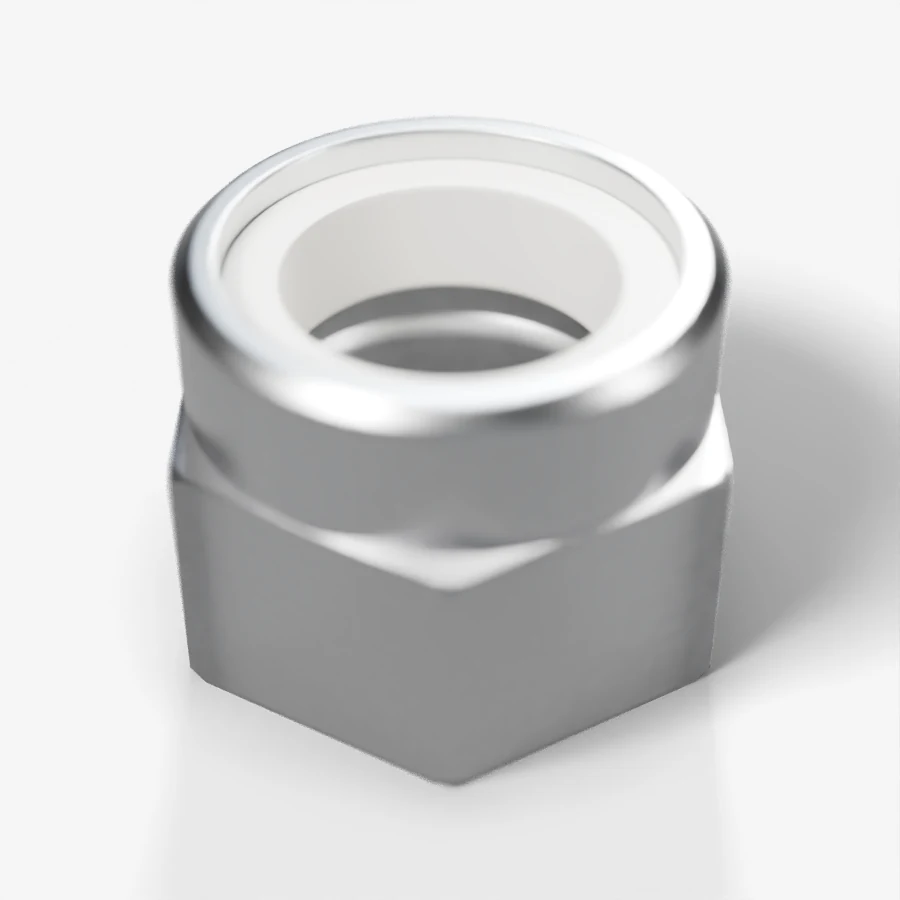
A lock nut resists rotation once tightened. Prevailing torque types do this by friction: a polyamide insert (nylock) grips the bolt thread, or a deformed metal top section squeezes it. Jam nuts are thin nuts tightened against a full nut. Slotted and castle nuts are locked mechanically with a split pin through a drilled bolt. Lock nuts are used on rotating and vibrating equipment, pipe supports subject to vibration and fixings that cannot be retightened often.
Key features
- Nylon insert lock nuts to ISO 7040 (regular) and DIN 985 (thin)
- All-metal prevailing torque nuts to DIN 980 / ISO 7042 for higher temperatures
- Hex jam, heavy hex jam, slotted and castle nuts to ASME B18.2.2
- Carbon steel class 8 / 10 and stainless A2 / A4
- Zinc, hot-dip galvanised or plain finish
Specification
| Supply | OEM manufacturer — Teshi Group, India |
|---|---|
| Nylon insert | ISO 7040, DIN 985 |
| All-metal prevailing torque | DIN 980, ISO 7042 |
| Jam / slotted / castle | ASME B18.2.2 hex jam, heavy hex jam, hex slotted, hex castle nuts |
| Grades — carbon steel | ASTM A307 Gr A / B, ASTM A563 nuts, SAE J429 Gr 2 / 5 / 8, ISO 898-1 class 4.6, 5.6, 8.8, 10.9, 12.9; ASTM F3125 (A325, A490) |
| Grades — alloy steel | ASTM A193 B7, B7M, B16; nuts ASTM A194 2H, 2HM, 3, 7, 7M, 16 |
| Grades — low-temperature | ASTM A320 L7, L7M, L43; nuts ASTM A194 7 / 7M with S3 impact test |
| Grades — high-temperature | ASTM A453 Gr 660 (A286, UNS S66286); ASTM A193 B16 |
| Grades — stainless steel | ASTM A193 / A320 B8, B8M, B8T, B8C (Class 1 and Class 2); nuts ASTM A194 8, 8M, 8T, 8C, 8F; ISO 3506 A2-70, A4-70, A4-80; ASTM F593 / F594 |
| Grades — 904L and 6Mo | 904L (UNS N08904), 254 SMO / 6Mo (UNS S31254) |
| Grades — duplex and super duplex | Duplex UNS S31803 / S32205 and super duplex UNS S32750 / S32760 (ASTM A1082 bolting, A276 / A479 bar) |
| Grades — nickel alloys | Monel 400 (ASTM B164, N04400), Monel K-500 (B865, N05500), Inconel 600 (B166, N06600), Inconel 625 (B446, N06625), Inconel 718 (B637, N07718), Incoloy 825 (B425, N08825), Hastelloy C276 (B574, N10276), Alloy 20 (B473, N08020) |
| Grades — titanium | ASTM B348 Grade 1, 2, 5 (Ti-6Al-4V), 7, 12 |
| Grades — copper-nickel | Cu-Ni 90/10 (C70600) and 70/30 (C71500) against order |
| Grade availability | Every grade listed is made or supplied against order, with EN 10204 3.1 certificates (3.2 / third-party inspection when specified) and PMI on alloy, stainless, duplex and nickel grades. |
| Threads | ISO metric coarse and fine; UNC / UNF |
| Finish | Plain, zinc electroplated, hot-dip galvanised |
| Documents | EN 10204 3.1 mill test certificate (3.2 / third-party inspection when specified), dimensional inspection report |
Applications
- Pumps, compressors and rotating equipment
- Vibrating pipe supports and skids
- Conveyor and material-handling equipment
- Electrical and instrument panels
Nylon insert vs all-metal lock nut
A nylon insert nut (ISO 7040 / DIN 985) locks by a polyamide ring that deforms around the bolt thread. It gives consistent locking but the insert limits service temperature, commonly to about 120 °C, and degrades with repeated reuse. An all-metal prevailing torque nut (DIN 980 / ISO 7042) locks by a deformed steel section, so it suits higher temperatures and solvent exposure, at the cost of higher installation torque.
FAQ
Lock Nuts: common questions
What is a nylock nut?
A nylock nut is a hex nut with a nylon (polyamide) insert ring at the top that grips the bolt thread and resists loosening. ISO 7040 and DIN 985 cover these nuts.
Can lock nuts be reused?
Prevailing torque lock nuts lose some locking torque each time they are removed and refitted. On critical or vibrating joints, replace them with new nuts, and always replace any nut whose locking torque has dropped noticeably.
When should a castle nut be used?
Use a castle or slotted nut where positive mechanical locking with a split pin is needed, such as on shafts, linkages and safety-critical rotating parts.
What is a jam nut?
A jam nut is a thin hex nut tightened against a standard nut to lock it, or used where space is limited. ASME B18.2.2 covers hex jam and heavy hex jam nuts in inch sizes.
Need a size or grade not listed here?
Our engineering team manufactures against your drawing or datasheet, with dimensional sign-off before dispatch.
Send us your specificationTraceability
From mill heat to your site
- 01
Approved mill material
Received against the mill certificate; heat number registered.
- 02
Forging & machining
Heat number carried through every stage in our Indian works.
- 03
PMI, dimensional & NDT
Every lot inspected to the governing standard; TPI witness on request.
- 04
Stamped & certified dispatch
Hard-stamped pieces with EN 10204 3.1 / 3.2 certificates.
Quick RFQ
Quote for Lock Nuts in 24–48 hours
More fasteners
All fastenersFlat & Spring Washers
ASME B18.22.1 · ASME B18.21.1
View productFastenersStud Bolts
ASTM A193 · ASTM A320
View productFastenersHex & Heavy Hex Bolts
ASME B18.2.1 · ISO 4014
View productFastenersHeavy Hex Nuts
ASTM A194 · ASME B18.2.2
View productFastenersSocket Head Cap Screws
ASME B18.3 · ISO 4762
View productFastenersCarriage Bolts
ASME B18.5 · DIN 603
View product