OEM manufacturer ASME B16.5 (flange end) · Manufacturer standard (body)
Expander Flanges — ASME B16.5 Flange End
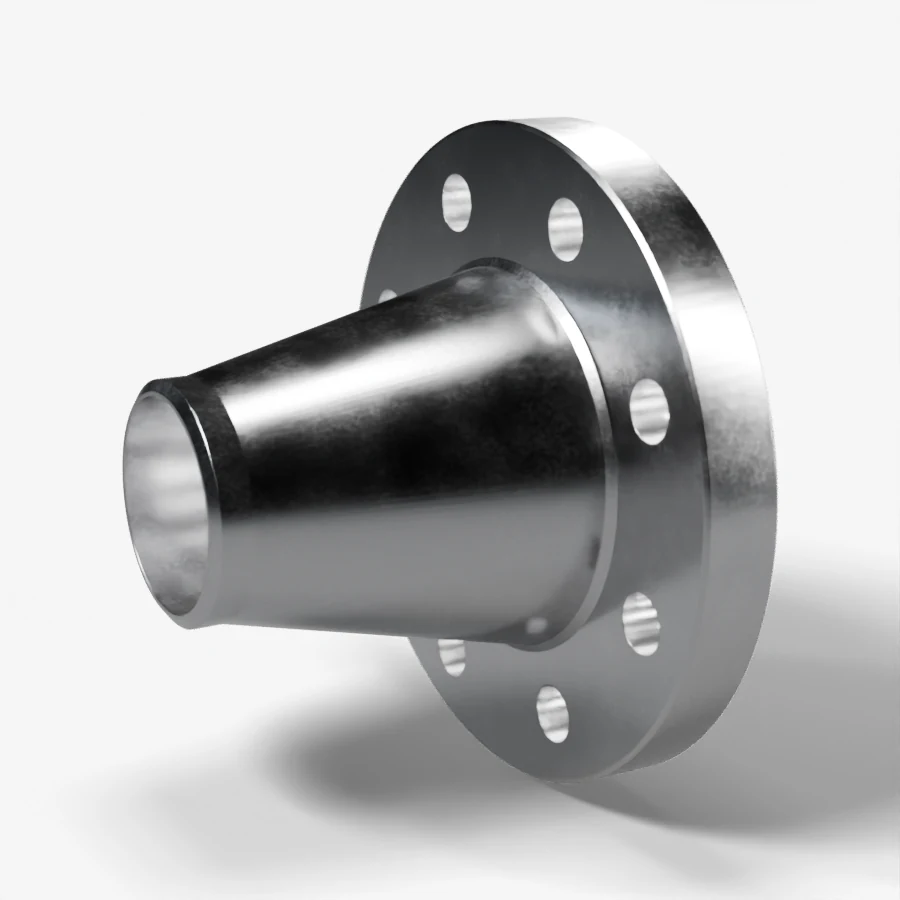
An expander flange is a weld neck flange with a long tapered hub that increases the line size by one or two nominal sizes at the flange. Teshi Group manufactures expander flanges with the flange end drilled and faced to ASME B16.5 and the body to manufacturer standard or client drawing.
Also called: expanding flange, increasing flange, expander weld neck flange
What is an Expander Flange?
An expander flange combines a reducer and a weld neck flange in one forging. The weld end matches the smaller pipe; the flange end matches a larger valve, pump or equipment nozzle, for example a 4″ pipe to a 6″ valve. It removes a reducer and a butt weld, and so shortens the spool. ASME B16.5 does not give dimensions for the expander body, so length and taper follow the manufacturer's standard or the purchaser's drawing, while the flange end follows B16.5.
Key features
- Flange end of the larger NPS to ASME B16.5
- Weld end bored and bevelled for the smaller pipe
- Typically increases size by one or two NPS
- Replaces a reducer plus weld neck flange
- RF, FF or RTJ facing
Specification
| Supply | OEM manufacturer — Teshi Group, India |
|---|---|
| Standard | Flange end to ASME B16.5; expander body to manufacturer standard / client drawing |
| Size range | To order; typical increase of one or two NPS |
| Pressure class | Class 150–2500 flange end, as specified |
| Facing | RF, FF, RTJ |
| Materials — carbon steel | ASTM A105 / A105N; ASTM A181 Cl 60, Cl 70; ASTM A266 Gr 2, Gr 4 (large forgings) |
| Materials — high-yield carbon steel | ASTM A694 F42, F46, F48, F50, F52, F56, F60, F65, F70 (MSS SP-44 grades F52–F70) |
| Materials — low-temperature carbon steel | ASTM A350 LF1, LF2 Cl 1, LF2 Cl 2, LF3, LF6, LF9 |
| Materials — alloy steel (Cr-Mo) | ASTM A182 F1, F2, F5, F5a, F9, F11 Cl 1 / 2 / 3, F12 Cl 1 / 2, F21, F22 Cl 1 / 3, F22V, F91, F92, F911; ASTM A336 F11, F22 (large forgings) |
| Materials — stainless steel | ASTM A182 F304, F304L, F304H, F304LN, F309H, F310, F316, F316L, F316H, F316LN, F316Ti, F317, F317L, F321, F321H, F347, F347H, F348 |
| Materials — 904L and 6Mo | 904L (ASTM A182 F904L, UNS N08904); 254 SMO / 6Mo (ASTM A182 F44, UNS S31254); AL-6XN (ASTM A182 F62, UNS N08367) |
| Materials — duplex stainless steel | ASTM A182 F51 (UNS S31803), F60 (UNS S32205, 2205) |
| Materials — super duplex stainless steel | ASTM A182 F53 (UNS S32750, 2507), F55 (UNS S32760), F61 (UNS S32550) |
| Materials — nickel alloys | ASTM B564 / B160 / B462: Nickel 200 / 201 (N02200 / N02201), Monel 400 (N04400), Monel K-500 (N05500), Inconel 600 (N06600), Inconel 625 (N06625), Inconel 718 (N07718), Incoloy 800 / 800H / 800HT (N08800 / N08810 / N08811), Incoloy 825 (N08825), Hastelloy C276 (N10276), Hastelloy C22 (N06022), Hastelloy B2 / B3 (N10665 / N10675), Alloy 20 (N08020) |
| Materials — titanium | ASTM B381 Grade F1, F2, F5 (Ti-6Al-4V), F7, F12 |
| Materials — copper-nickel | Cu-Ni 90/10 (UNS C70600) and 70/30 (UNS C71500), ASTM B151 bar; flanges to ASME B16.5 or EEMUA 145 |
| Grade availability | Every grade listed is made or supplied against order, with EN 10204 3.1 certificates (3.2 / third-party inspection when specified) and PMI on alloy, stainless, duplex and nickel grades. |
| Testing | Visual and dimensional inspection, PMI on alloy and stainless grades, hardness; UT, MPI/DPI as specified |
| Documents | EN 10204 3.1 mill test certificate; 3.2 / third-party inspection when the order specifies; dimensional inspection report; IBR certification when specified |
Applications
- Pump and compressor inlet and outlet connections
- Control valve stations with a larger valve body
- Equipment nozzles larger than the connected line
- Compact skids where spool length is limited
Expander flange vs reducing flange
A reducing flange has a larger flange ring bored for a smaller pipe, with a sudden step at the bore. An expander flange has a long tapered hub that increases the bore gradually from the small pipe to the larger flange, so flow transition is smoother and it behaves more like a reducer. Expanders are preferred where flow disturbance or pressure drop matters.
Technical data sheets
Dimensions & weights
FAQ
Expander Flange: common questions
Is the expander flange an ASME standard part?
Only its flange end is. ASME B16.5 governs the flange OD, thickness, drilling and facing. The tapered body is to manufacturer standard or drawing, so share the required overall length if space matters.
How much can an expander flange increase the size?
Typically one or two nominal pipe sizes. For larger increases, or where a long transition is needed, a concentric reducer with a standard weld neck flange is normally used instead.
What do I need to specify?
Give the smaller (weld end) NPS and schedule, the larger (flange end) NPS, class, facing, material and any overall length limit. Teshi Group quotes in 24–48 hours.
Can expander flanges be supplied in stainless steel?
Yes. They are made in ASTM A182 F304L and F316L as well as A105 and A350 LF2, with EN 10204 3.1 certificates, dimensional reports and PMI on stainless and alloy grades.
Need a size or grade not listed here?
Our engineering team manufactures against your drawing or datasheet, with dimensional sign-off before dispatch.
Send us your specificationTraceability
From mill heat to your site
- 01
Approved mill material
Received against the mill certificate; heat number registered.
- 02
Forging & machining
Heat number carried through every stage in our Indian works.
- 03
PMI, dimensional & NDT
Every lot inspected to the governing standard; TPI witness on request.
- 04
Stamped & certified dispatch
Hard-stamped pieces with EN 10204 3.1 / 3.2 certificates.
Quick RFQ
Quote for Expander Flange in 24–48 hours
More industrial flanges
All industrial flangesFlat Face Flange
ASME B16.5 · EN 1092-1 (Type A facing)
View productIndustrial FlangesTongue and Groove Flange
ASME B16.5 · EN 1092-1 (facing Type C / Type D)
View productIndustrial FlangesMale and Female Flange
ASME B16.5 · EN 1092-1 (facing Type E / Type F)
View productIndustrial FlangesSwivel Ring Flange
Manufacturer standard / client drawing · ASME B16.5 / B16.47 (mating bolt pattern)
View productIndustrial FlangesWeldoflange & Nipoflange
ASME B16.5 (flange end) · Manufacturer standard (body)
View productIndustrial FlangesSAE J518 Hydraulic Flange
SAE J518-1 (Code 61) · SAE J518-2 (Code 62)
View product